

Sanjay Puri in Conversation with Dr. James H. Dickerson on AI Standards and Innovation— RegulatingAI Podcast

RegulatingAI Podcast
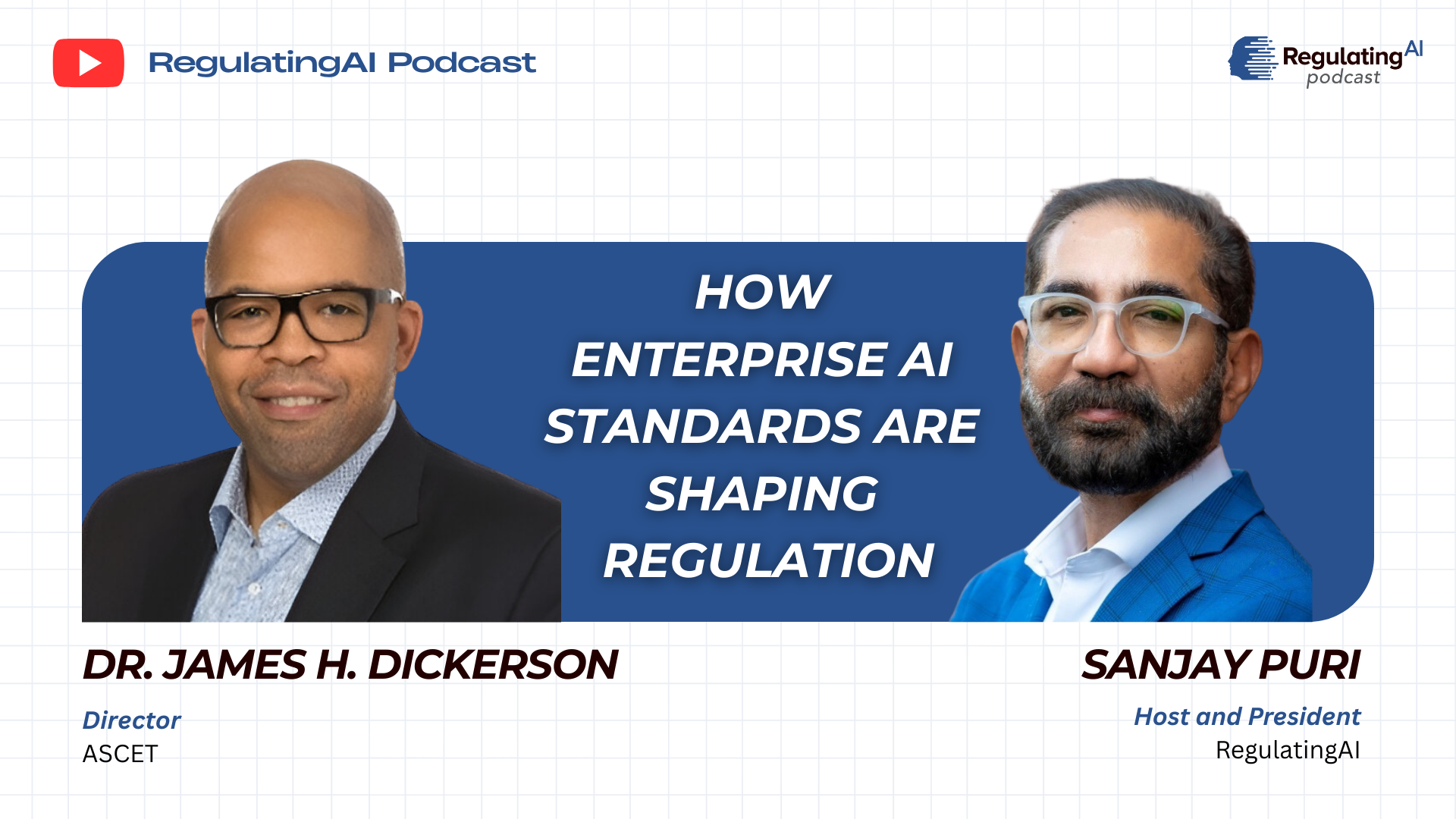
Dr. James H. Dickerson, Director of the ASCET Center of Excellence with Sanjay Puri, President, Knowledge Networks
AI standards don’t slow innovation—they fuel it. A Regulating AI podcast conversation with Dr. James H. Dickerson on standards as competitive strategy.
Dr. Dickerson’s perspective carries weight. A physicist by training with deep experience in nanomaterials, consumer advocacy, and national laboratories, he now leads a $15 million NIST-funded initiative focused on advancing standards for critical and emerging technologies, including AI. His message to founders, policymakers, and technologists is clear: if you’re not participating in standards development, you’re giving up strategic advantage.
What Is ASCET — and Why Does It Matter?
ASCET stands for Advancing Standardization for Critical and Emerging Technologies. Supported across U.S. administrations, the initiative aims to strengthen workforce development, accelerate commercialization, and ensure U.S. leadership in global standards. Its focus areas include AI, biotechnology, quantum technologies, and semiconductors.
Rather than acting as a regulator, ASCET serves as a hub and facilitator — connecting industry, academia, government, and standards development organizations. As Dr. Dickerson explained on the RegulatingAI Podcast, standards are not paperwork exercises; they are tools that define how innovation moves from the lab to the market.
Why Standards Are “Engines of Innovation”
One of the most striking moments in the conversation came when Dr. Dickerson stated: “Standards are the engines of innovation.” For many entrepreneurs, that idea feels counterintuitive. But his logic is simple. If you understand the road ahead — including its constraints — you can optimize your journey.
Participating in consensus-based standards allows companies to shape the very parameters that will define future markets. Instead of reacting to external rules, firms gain early insight into where technology, policy, and global expectations are heading. As Dr. Dickerson put it, this isn’t altruism — it’s a “selfish” but smart strategy that directly impacts whether your bottom line ends up red or black.
Premature Standards vs. Timely Standards
Skeptics often argue that premature standardization could slow AI progress or weaken U.S. competitiveness. Dr. Dickerson rejected this framing. The real issue, he explained, isn’t whether standards exist, but how they evolve.
Innovation and standards must move in concert, not in parallel. When they advance together, standards adapt to new discoveries while innovation benefits from clarity and shared direction. This approach has worked before — in semiconductors, nanotechnology, and now AI.
The Cost of Not Showing Up
For startups and smaller firms, the greatest risk isn’t overregulation — it’s lack of information. Dr. Dickerson warned that disengaging from standards leaves companies blind to shifts in technology, markets, and global norms. “A dearth of information,” he noted, “is the worst place to be.”
That’s especially true in a crowded AI standards landscape involving organizations like ISO, IEEE, IEC, and ITU. ASCET’s role is to help companies navigate this complexity, decide where engagement matters most, and avoid wasting precious time and resources.
From Standards to Regulation
As discussed on the RegulatingAI Podcast, the U.S. typically looks to standards before regulation. Over time, mature standards often inform laws and policies. For founders and policymakers alike, this makes early engagement essential. Standards don’t just shape products — they shape future regulation itself.
Who Will Lead AI?
Dr. Dickerson was unequivocal: the U.S. is currently a leader in global AI standards, but leadership requires continuous participation. Those who help define the “parameter space” of AI today will set the rules of global AI commerce tomorrow.
The takeaway from Sanjay Puri’s conversation is simple but profound: standards are strategy. And in AI, strategy decides who leads.
Upasana Das
Knowledge Networks
email us here
Visit us on social media:
LinkedIn
Instagram
Facebook
YouTube
X
Legal Disclaimer:
EIN Presswire provides this news content "as is" without warranty of any kind. We do not accept any responsibility or liability for the accuracy, content, images, videos, licenses, completeness, legality, or reliability of the information contained in this article. If you have any complaints or copyright issues related to this article, kindly contact the author above.
