

Battery Energy Storage System Market Size Demand Insights
The BESS opportunity is moving beyond backup power. As batteries become grid assets, the winners will be those who master duration, revenue stacking and project economics.
Wilmington, DE, United States, Sept. 08, 2026 (GLOBE NEWSWIRE) -- Battery Storage Shifted from Supporting Renewables to Determining their Commercial Viability
Storage has stopped being the accessory technology that helps renewables function and has become the asset class that determines whether renewable projects pencil out at all. A meaningful share of strategy teams still frame batteries as a downstream procurement line item, while developers who recalibrated early are now bidding for capacity slots that won't open again until late decade.
What looks externally like a fast-growing component market is, structurally, a contest over manufacturing access, mineral offtake, and grid interconnection queues. The battery energy storage systems market is being reorganized in favor of buyers who treated 2024 and 2025 as the procurement window rather than the planning window. That asymmetry is now visible in delivery timelines, contract structures, and the price curves quietly tightening across utility-scale tenders.
Request a Free Sample Report: https://marketmindsadvisory.com/request-sample/?report_id=5394
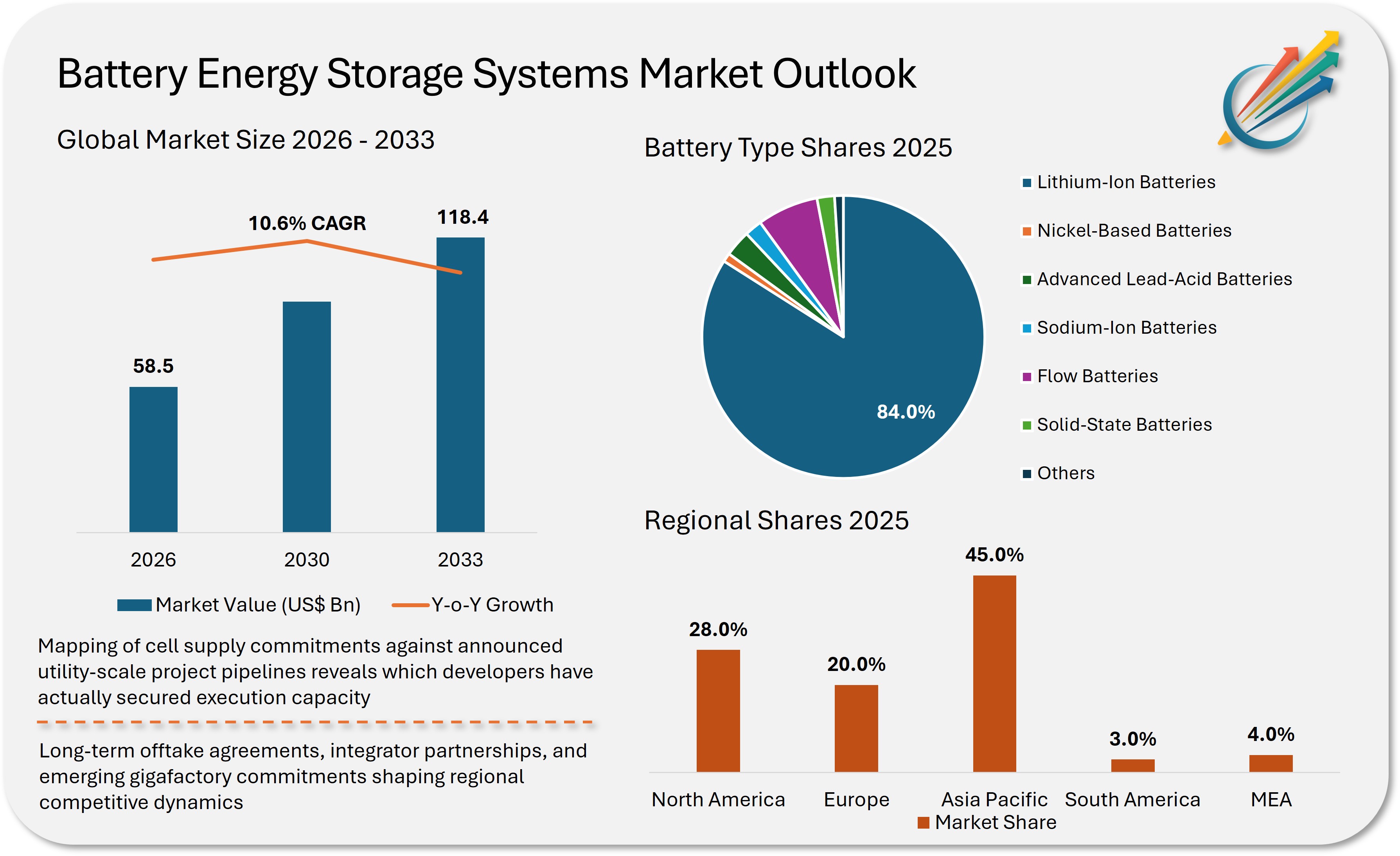
Key Takeaways from Battery Energy Storage Systems Market
- The battery energy storage systems market is projected to reach US$ 118.4 billion by 2033, expanding from US$ 58.5 billion in 2026
- Forecast period CAGR of 10.6% between 2026 and 2033, sustained by utility-scale deployment momentum
- Lithium iron phosphate chemistry now anchors the majority of new utility-scale installations
- Four-hour duration systems are emerging as the new commercial baseline for grid services contracts
- Project interconnection queues, not battery supply, have become the binding deployment constraint in mature markets
- Co-located solar-plus-storage now wins more capacity awards than standalone configurations in tier-one auctions
- Behind-the-meter commercial deployment is accelerating faster than residential, reversing earlier adoption assumptions
As per Research Manager from Market Minds Advisory, "The battery energy storage systems market has crossed from emerging-technology economics into hard infrastructure economics, and the buyers still negotiating on unit price are losing the more important battle on delivery slots. The next 18 months will separate companies with secured supply pipelines from those competing for whatever capacity remains."
The Procurement Advantage Early Movers Secured is Becoming Increasingly Difficult to Replicate
The structural conditions favoring early movers in the battery energy storage systems market are narrowing measurably. Manufacturing capacity is being committed through 2028, and the cost of late entry is no longer marginal.
- Supply commitments are hardening into multi-year obligations: Major cell manufacturers are increasingly allocating capacity through framework agreements rather than spot transactions, which means access is being claimed rather than purchased.
- Interconnection queues are now the binding constraint: In mature grids, the limiting factor has shifted from battery availability to grid access, reshaping where capital actually deploys.
-
Financing structures are maturing around bankable revenue stacks: Lenders are pricing storage assets against ancillary services, capacity markets, and energy arbitrage simultaneously, which rewards developers with sophisticated revenue modeling.
Battery Chemistry Decisions are Reshaping Competitive Advantage across the Market
The dominance of lithium iron phosphate at utility scale and the early commercial traction of sodium-ion in specific use cases are quietly redrawing the competitive map. The structural shift is less about new chemistry and more about who controls the qualified manufacturing footprint.
- LFP has become the default for stationary storage: The chemistry's cost trajectory, thermal stability, and cycle life have made it the practical baseline for four-hour duration systems, displacing earlier NMC assumptions in utility tenders.
- Sodium-ion is finding commercial entry points faster than expected: Lower energy density is acceptable in stationary applications where footprint matters less than cost per cycle, opening a credible second supply chain less exposed to lithium.
-
Flow batteries are gaining traction for long-duration applications: Eight-hour and above duration requirements are where flow chemistries become structurally advantaged, and project developers are increasingly specifying them for specific grid services rather than as experimental pilots.
The Market is Evolving Faster than Conventional Forecast Models Suggest
A meaningful share of announced storage pipelines will not reach commercial operation on their stated timelines. Interconnection delays, permitting friction, and grid upgrade dependencies will compress real deployment well below pipeline headline figures. Identifying which projects actually execute is now the more valuable analytical question than tracking pipeline growth.
Cell pricing will decouple from raw material trajectories sooner than most forecasts assume. Manufacturing scale, automation gains, and chemistry substitution are now the dominant cost drivers. Lithium price spikes that previously cascaded directly into system costs are being absorbed inside increasingly vertically integrated supply chains.
The behind-the-meter commercial segment will outpace residential storage growth in absolute terms. Demand charge economics, resilience requirements, and on-site solar pairing make commercial buildings a more compelling unit economic case than residential installations in most mature markets.
A New Competitive Structure is Emerging across Energy Storage Infrastructure
Renewable Integration Has Become Mechanically Dependent on Storage
Solar and wind project economics increasingly require storage to manage curtailment, capture peak pricing, and meet capacity market obligations. The battery energy storage systems market is now structurally linked to renewable expansion in a way that makes the two categories economically inseparable. Developers building without integrated storage strategies are watching capture prices erode in markets with high renewable penetration.
Grid Modernization Is Pulling Storage into Essential Infrastructure Status
Transmission constraints, frequency regulation requirements, and aging grid assets are positioning storage as a substitute for traditional grid investment in many jurisdictions. Utilities are increasingly procuring storage as a non-wires alternative, treating it as a strategic asset rather than a procurement step. This shift is restructuring how regulated revenues flow toward storage assets.
Vertical Integration Is Reshaping Margin Capture across the Stack
System integrators, cell manufacturers, and project developers are converging on hybrid business models that capture margin at multiple stages. The companies positioning across cells, balance-of-system, software, and operations are accessing value pools that pure-play participants cannot. This integration trend is squeezing the middle of the value chain.
Software and Optimization Are Becoming the Quiet Differentiator
The hardware comparison between system providers has narrowed substantially, but performance differences in real-world deployment are widening. Energy management software, bidding algorithms, and degradation models now determine which assets actually deliver projected returns. Buyers are starting to procure software capability with the same rigor previously reserved for hardware specifications.
Structural Risks Behind Market’s Rapid Expansion are Becoming Hard to Ignore
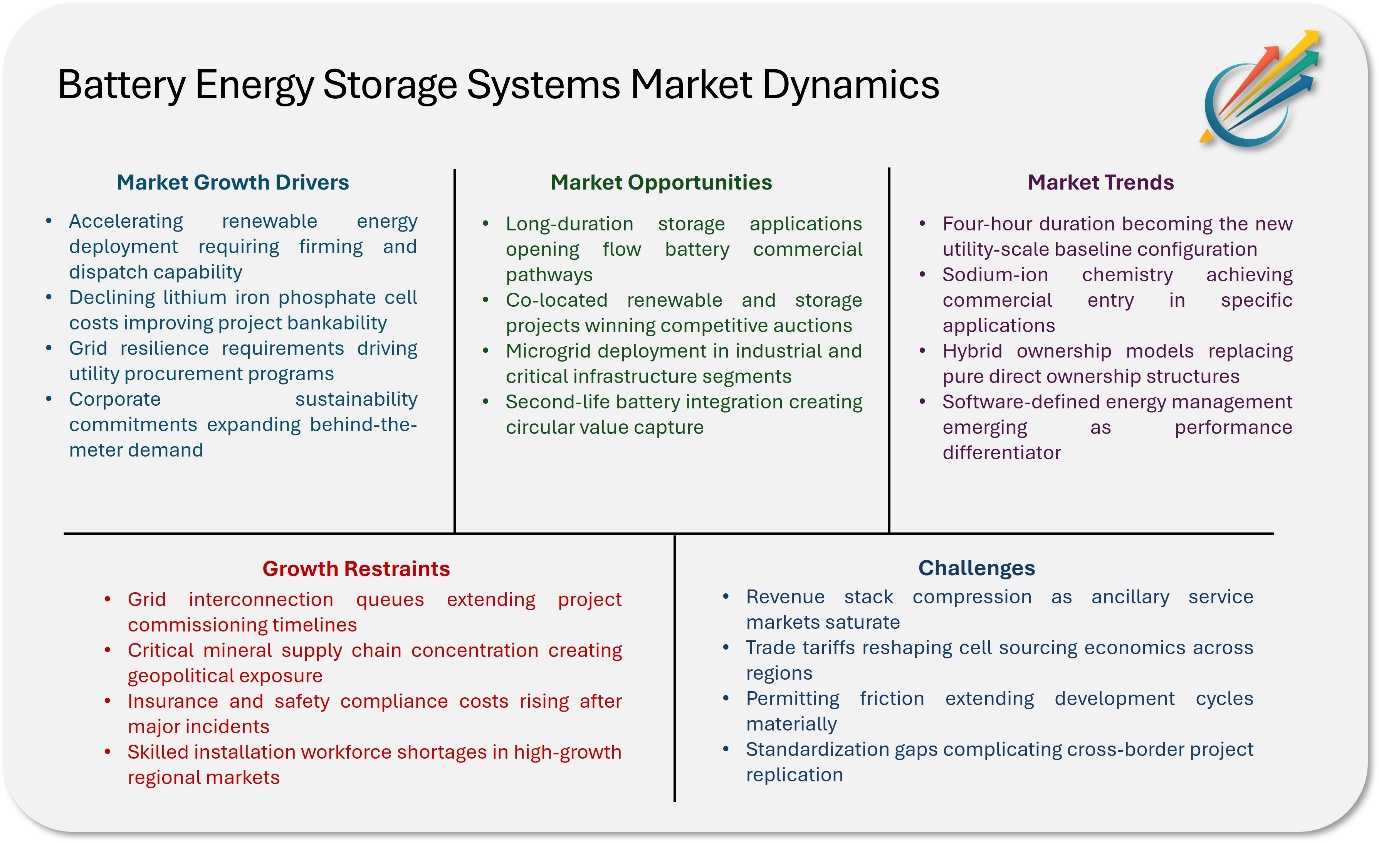
- Critical mineral supply concentration: Lithium, cobalt, and nickel supply chains remain concentrated in a small number of jurisdictions, creating geopolitical exposure that pricing models often understate
- Interconnection and permitting bottlenecks: Grid connection backlogs in mature markets are extending project timelines well beyond initial financial models, eroding return assumptions
- Safety incidents and insurance reset: High-profile fire incidents at utility-scale sites are tightening insurance availability and raising compliance costs across the asset class
- Policy and incentive volatility: Shifts in tax credit structures, capacity market rules, and trade tariffs can materially reset project economics within short windows
- Workforce and EPC capacity constraints: Qualified installation and commissioning talent is scarce in several growth markets, slowing the conversion of contracts into commissioned assets
- Revenue stack uncertainty in evolving markets: Ancillary service price compression as more storage enters markets creates revenue model risk for late-stage entrants.
These risks are real but not directional. They will reshape who wins rather than whether the market grows.
Market Dynamics Shaping the Battery Energy Storage Systems Market
Battery Energy Storage Systems Market Segmentation
By Battery Type
- Lithium-Ion Batteries
- Lithium Cobalt Oxide
- Lithium Iron Phosphate
- Lithium Manganese Oxide
- Others
- Nickel-Based Batteries
- Nickel-Metal Hydride
- Nickel-Cadmium
- Advanced Lead-Acid Batteries
- Sodium-Ion Batteries
- Flow Batteries
- Solid-State Batteries
- Others
Lithium iron phosphate has established itself as the structural anchor of utility-scale deployment, driven by cost trajectory, thermal characteristics, and cycle life suited to stationary applications in the battery energy storage systems market. Sodium-ion is gaining commercial entry where energy density is less critical than supply chain diversification. Flow batteries are carving defensible territory in long-duration use cases above six hours. The chemistry choice is increasingly a strategic decision rather than a technical one, with implications for supply security, project economics, and regulatory exposure.
By Connection Type
- On Grid (Front-of-the-meter)
- Power Generation & Utilities
- Commercial & Industrial
- Hybrid Systems (Renewable)
- Off Grid (Behind-the-meter)
- Commercial & Industrial
- Hybrid Systems (Renewable)
- Residential
- Telecom Power
- Critical Infrastructure
- Others
Front-of-the-meter deployment continues to dominate aggregate capacity additions, anchored by utility procurement and renewable integration mandates. Behind-the-meter is the more interesting structural story, with commercial and industrial deployment outpacing residential growth in absolute volume terms. Telecom and critical infrastructure represent stable, contract-driven demand pools that often get underweighted in growth analyses. The connection type segmentation now functions as a proxy for revenue model and risk profile rather than just installation location in battery energy storage systems market.
By Business Model
- Direct Ownership
- Third Party Ownership
- Energy-as-a-storage Service
- Utility Contracting & Ancillary Services
- Hybrid Ownership
The shift away from pure direct ownership toward third-party and as-a-service structures reflects the maturation of project finance and the rising sophistication of asset operators. Energy-as-a-service models are particularly compelling for commercial customers seeking resilience without balance sheet exposure in the battery energy storage systems market. Hybrid ownership structures are emerging as the practical answer to complex revenue stacks that mix merchant exposure, contracted capacity, and ancillary services. Business model selection now materially affects achievable returns and risk allocation.
By Power Capacity
- Low Capacity (<100 kWh)
- Medium Capacity (100 kWh - 1,000 KWh)
- Commercial Level (1 - 10 MWh)
- Utility Level (Above 10 MWh)
Utility-level systems above 10 MWh account for the majority of capacity additions and continue to scale toward 100 MWh and above standard configurations in the battery energy storage systems market. Commercial-level deployment is the fastest-growing tier in unit terms, driven by behind-the-meter economics. Medium and low capacity segments serve specialized applications where modularity and deployment speed outweigh per-unit cost advantages. The capacity tier increasingly determines which integrators and developers can credibly compete, with utility-scale becoming a barrier-to-entry segment.
By Application
- Grid Services
- Renewable Energy Integration
- Peak Shaving
- Back-up (UPS)
- Others
Grid services and renewable integration together represent the volume center of demand, with applications increasingly blending across both categories in battery energy storage systems market. Peak shaving remains a reliable demand driver in commercial settings with elevated demand charges. Backup and UPS applications represent stable, less price-sensitive demand particularly in data center and critical infrastructure contexts. Application boundaries are blurring as multi-revenue stack operation becomes standard, which rewards operators with sophisticated dispatch capability.
Shape this report around your priorities: https://marketmindsadvisory.com/request-customization/?report_id=5394
Regional Market Outlook
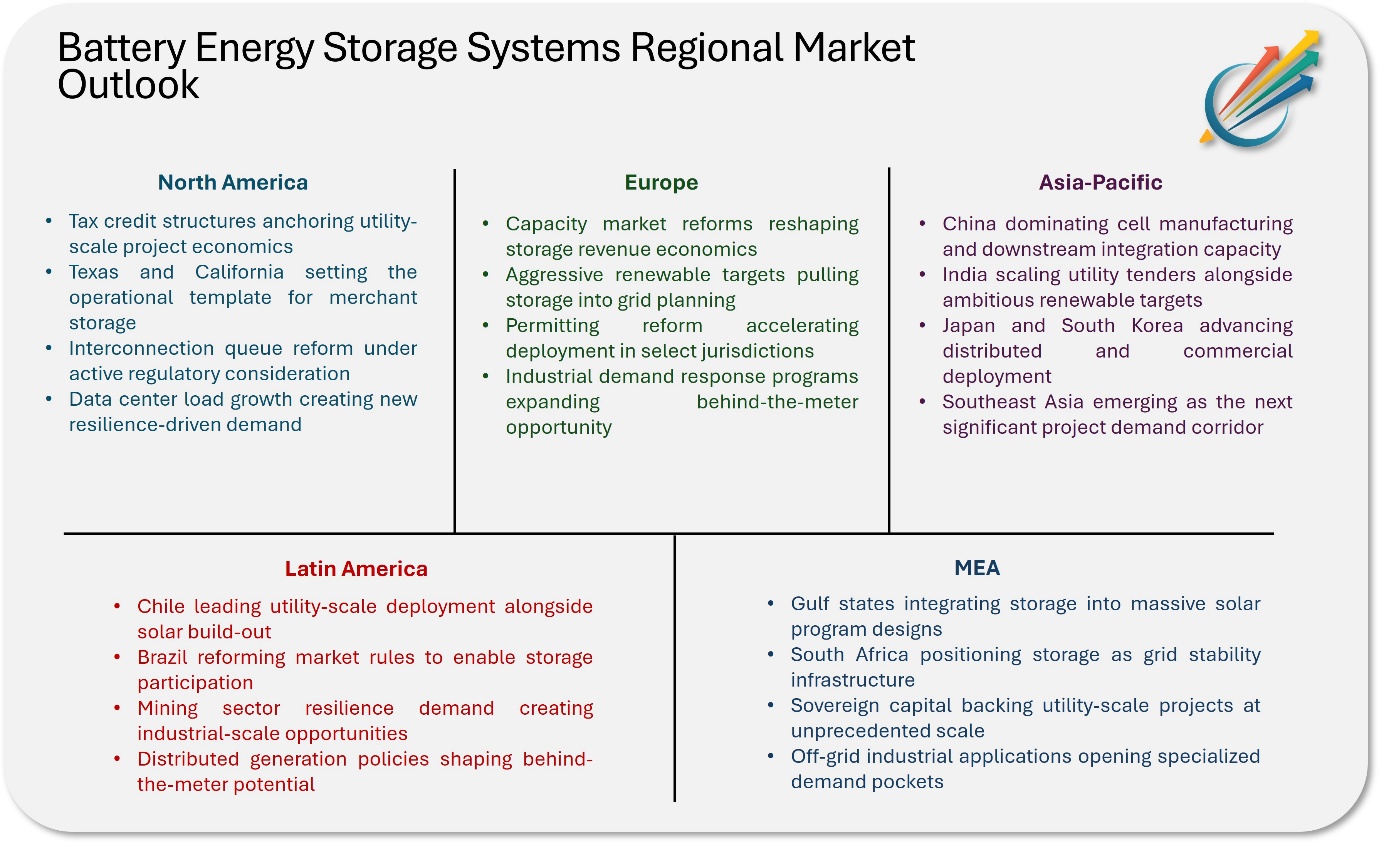
Investment Focus where the High Value Opportunity is Concentrating
Vertically Integrated Cell and System Capability
Companies controlling both cell manufacturing and system integration are capturing the widest margin pool. The integration captures value that is otherwise distributed across the supply chain and provides supply security that customers increasingly pay premiums to access. This positioning is becoming difficult to replicate at scale, which strengthens defensibility for established integrated players.
Software and Energy Management Platforms
The asset performance gap between well-optimized and poorly-optimized storage installations is widening, and customers are starting to recognize this. Companies with proven dispatch algorithms, degradation models, and revenue optimization capability are commanding premium positioning in tenders. The software layer is becoming the durable differentiator the hardware layer no longer provides.
Long-Duration Storage Specialization
Applications above six hours of duration remain underserved by lithium-based systems and represent the next frontier of competitive positioning. Flow batteries, thermal storage, and emerging chemistries are finding commercial traction where economics favor extended duration. Early specialists are establishing footholds that will compound as duration requirements expand across grid services contracts.
Project Development with Secured Supply
Developers who locked in cell supply commitments and interconnection positions early are now structurally advantaged in winning contracts. The asset base they are building is being procured at cost positions and timeline advantages that late entrants cannot replicate. This category of value capture is concentrated in a relatively small number of well-positioned developers.
What This Means for Decision-Makers
Utilities & Grid Operators - Storage procurement has become a strategic capability rather than a periodic purchasing exercise. Organizations building dedicated storage strategy functions, supplier relationships, and operational expertise will outperform those treating each procurement as a discrete transaction.
Project Developers - Securing cell supply and interconnection positions now matters more than optimizing for marginal cost reductions later. The developers with locked-in supply commitments and grid access are bidding from structurally advantaged positions that recent entrants cannot easily match.
Investors - The battery energy storage systems market has matured past pure technology speculation into infrastructure economics. Integrated developers, software platforms, and supply-secured manufacturers offer clearer risk-return profiles than early-stage chemistry plays without sacrificing growth exposure.
Policymakers - Interconnection reform, permitting acceleration, and clarity on revenue stack treatment are now the binding policy questions. The deployment pace the energy transition requires depends less on incentive expansion and more on removing the procedural frictions that currently throttle commissioning.
Competitive Landscape: Battery Energy Storage Systems Market
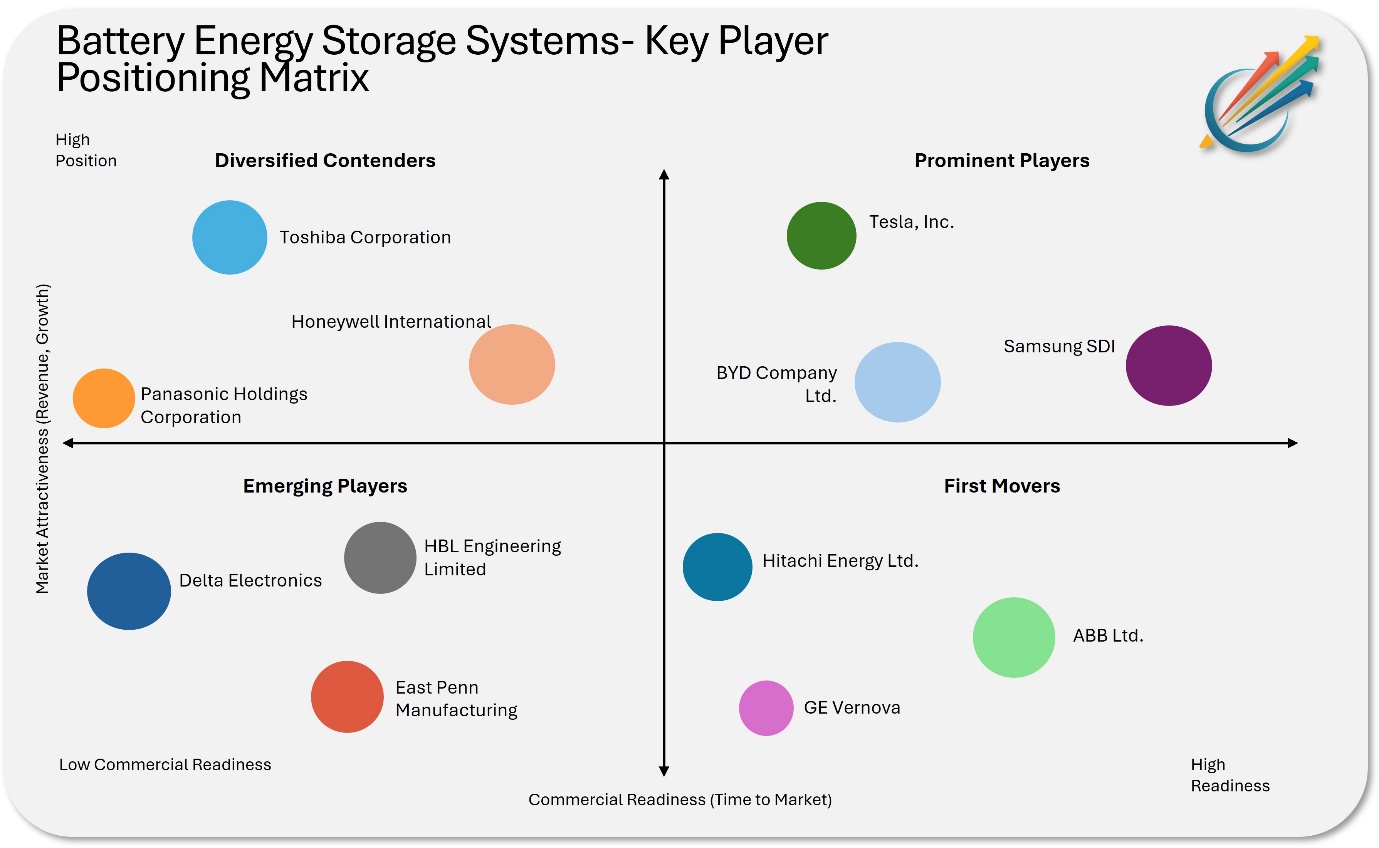
Recent Market Developments
- In April 2026, Tesla, Inc. expanded Megapack production output to address rising utility-scale project demand across North American and European markets
- In March 2026, CATL announced a strategic partnership focused on long-duration energy storage applications targeting grid services contracts
- In February 2026, Fluence Energy, Inc. introduced an upgraded grid-scale platform aimed at improving cycle efficiency and integration with renewable assets
- In January 2026, LG Energy Solution committed additional production capacity dedicated to stationary storage applications, separating it from electric vehicle cell allocation.
Get Access to complete Analysis, Buy Now: https://marketmindsadvisory.com/buy-now/?report_id=5394
Trending Reports
- Advanced Energy Storage System Market
- Stationary Lithium-Ion Battery Storage Market
- Residential Solar Energy Storage Market
- Hybrid Solar Wind Diesel Market
- Battery Technology Market
- Solar Junction Box Market
- Flywheel Energy Storage Market
- EV Thermal System Market
- Industrial Energy Management System Market
- Silent Generator Market
Market is segmented by Battery Type (Lithium-Ion, Sodium-Ion, Flow, Solid-State), Connection Type (On-Grid, Off-Grid), Business Model (Direct Ownership, Third Party, Energy-as-a-Service), and Power Capacity (Low, Medium, Commercial, Utility-Level)
Why choose Market Minds Advisory
Market Minds Advisory delivers decision-grade intelligence to executives across machinery, packaging, chemicals, automotive, ICT, food and beverage, consumer goods, and healthcare. We help organizations sharpen market expansion strategies, accelerate share gains, refine brand positioning, and enable account-level growth. Our forecasting integrates primary interviews, proprietary demand models, and continuous market validation, producing the kind of clarity volatile and emerging industries require. Backed by over a decade of sector expertise, our research surfaces white space, opportunity gaps, and competitive blind spots, accounting for recent developments and geopolitical risk. We help businesses see the future of their markets.
Contact Us
Market Minds Advisory
1521 Concord Pike, Suite 301
Wilmington, DE 19803
United States
Email: sales@marketmindsadvisory.com
Website: https://marketmindsadvisory.com/


Legal Disclaimer:
EIN Presswire provides this news content "as is" without warranty of any kind. We do not accept any responsibility or liability for the accuracy, content, images, videos, licenses, completeness, legality, or reliability of the information contained in this article. If you have any complaints or copyright issues related to this article, kindly contact the author above.
